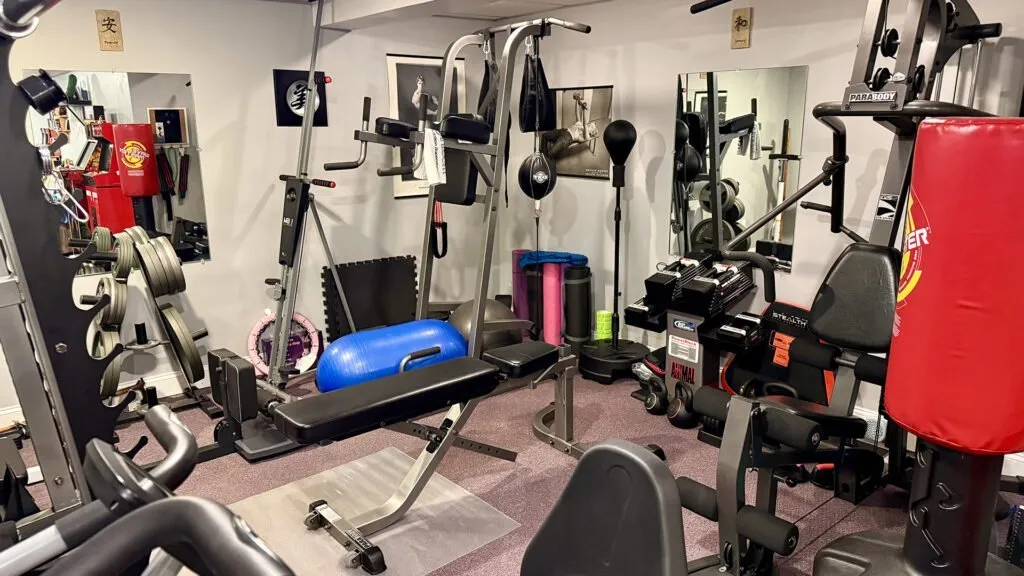
Although I go to a commercial gym, I still have a very good home gym as a backup.
High-level bodybuilding and fitness typically involves considerable dedication and, more often than not, especially these days, copious amounts of pharmaceutical assistance. That has been true on a wide scale since at least the 1960s, but the scale has long since passed its tipping point, fueled ever further by the insatiable social media machine. Algorithmic pressures demanding constant visual perfection push athletes to extremes, and surveys of male competitive bodybuilders commonly find that a majority—between half and three-quarters—report using anabolic-androgenic steroids (AAS) (Smoliga et al., 2023). A 2026 study in Body Image of more than 1,500 boys and men in the US and Canada found that the more muscularity-focused and drug-promoting content they saw on social media, the stronger their intentions to use AAS — with content promoting muscle-building drugs showing the strongest association of all. To put it simply, more people than ever participating means higher percentages of everything, including very bad outcomes.
Unfortunately, the deaths at relatively young ages across the hardcore bodybuilding and fitness communities over the last half decade are not just a perception. They are now documented. Vecchiato and colleagues (2025) tracked 20,286 male bodybuilders who competed in IFBB events between 2005 and 2020 and identified 121 deaths, at a mean age of just 45. Sudden cardiac death accounted for 38% of those deaths, including 11 athletes who were still actively competing, at a mean age of 34.7 — and professional bodybuilders had more than five times the sudden cardiac death risk of amateurs. Available autopsies consistently showed enlarged hearts and ventricular hypertrophy.
Some enthusiasts prefer to place the blame on COVID vaccinations, or on the idea that gear and vaccinations don’t mix. The data simply doesn’t bear that out. For one thing, this pattern long predates those vaccines: Mohammed Benaziza died in 1992 at 33 after extreme diuretic-driven dehydration, and Andreas Münzer died in 1996 at 31 with a 636-gram heart — roughly double normal weight — dangerously elevated potassium, and traces of some 20 different drugs in his system. For another, a JAMA Network Open study found no increase in sudden cardiac arrest or sudden cardiac death among young US competitive athletes during the pandemic and vaccine rollout compared with the three years before it (203 cases in 2017–2019 vs. 184 in 2020–2022). What the longitudinal data actually implicates is the gear itself. In a Danish registry cohort, men sanctioned for AAS use had, over roughly 11 years of follow-up, three times the risk of heart attack, nearly nine times the risk of cardiomyopathy, and substantially elevated risks of heart failure and arrhythmias compared with matched controls (Windfeld-Mathiasen et al., 2025). And Baggish et al. (2017) found that long-term users had measurably weaker hearts than non-using lifters — an ejection fraction of 52% versus 63% — along with more coronary plaque, in amounts that rose with lifetime use.
So why is this “steroids in bodybuilding” community particularly susceptible when AAS use exists in other sports too? Because the exposure pattern is different in almost every way that matters. Athletes in other sports tend to use fewer compounds, they’re more likely to be monitored, and they typically come off for their off-seasons, focusing on functional recovery rather than sheer mass. Bodybuilding, uniquely, rewards maximum mass and extreme leanness simultaneously — and the final push for stage condition routinely involves pharmaceutical diuretics and insulin, which acutely strain the heart through severe dehydration, critical electrolyte imbalances, and blood-sugar crashes (Cadwallader et al., 2010). Benaziza and Münzer weren’t killed by a mystery. They were killed by exactly that playbook, thirty years ago.
The ‘Mass Monster’ Era vs. The Golden Age
Modern hardcore bodybuilders do little of the cycling seen in functional sports. They tend to use many compounds simultaneously at massive doses, they don’t monitor their health closely — bloodwork, blood pressure, and cardiac imaging would mean confronting what the drugs are doing, often through doctors they’d have to be honest with about illegal use — and they cycle off far less than they should. That is one of the big reasons bodybuilders in the 1970s were generally healthier. The toolkit was smaller, growth hormone and insulin were not yet standard, and a big part of the sport was cycling on mainly to prepare for an upcoming contest. The onset of the “mass monster” era normalized year-round use and the stacking of massive AAS doses with growth hormone and insulin, pushing the human heart to support physiques it was never designed to sustain. That doesn’t mean those earlier guys didn’t have their issues, of course. But it’s nothing like what it’s become.
The Teen Influencer Pipeline
Another unique factor is timing. Not only are today’s athletes taking more extreme measures, but thanks to the rise of the teen influencer, they’re starting younger than ever. There used to be an idea that you build a natural foundation first, go as far as that takes you, and only then, if you show potential, hop on relevant gear. Now it’s often gear first, then start to train — with SARMs and peptides marketed on social media as the easy on-ramp. Disrupting the endocrine system before it has fully matured risks prolonged testosterone suppression and cardiovascular remodeling before an athlete even hits his twenties. It’s foolish, it’s broken, and it’s a sure path to significant health issues early in life.
Unlike today’s gear-first culture, I started in a different era. I’m 54 now and have been lifting weights since I was a teen. I never drank, smoked, or did any drugs. I’m not the healthiest out there, and I don’t have the best physique, but I do try to optimize both without the slightest thought of pharmaceutical assistance. I know it can be hard, especially when you’re very young, to have that kind of long-term outlook. But it’s a lot better than the alternative.

References
Astley, C., Petek, B. J., DeLong, R. N., et al. (2025). Sudden cardiac arrest among young competitive athletes before and during the COVID-19 pandemic. JAMA Network Open, 8(2), e2461327. https://doi.org/10.1001/jamanetworkopen.2024.61327
Baggish, A. L., Weiner, R. B., Kanayama, G., Hudson, J. I., Lu, M. T., Hoffmann, U., & Pope, H. G., Jr. (2017). Cardiovascular toxicity of illicit anabolic-androgenic steroid use. Circulation, 135, 1991–2002.
Cadwallader, A. B., De La Torre, X., Tieri, A., & Botrè, F. (2010). The abuse of diuretics as performance-enhancing drugs and masking agents in sport doping: Pharmacology, toxicology and analysis. British Journal of Pharmacology, 161, 1–16. https://doi.org/10.1111/j.1476-5381.2010.00789.x
Smoliga, J. M., Wilber, Z. T., & Robinson, B. T. (2023). Premature death in bodybuilders: What do we know? Sports Medicine, 53, 933–948. https://doi.org/10.1007/s40279-022-01801-0
Vecchiato, M., et al. (2025). Mortality in male bodybuilding athletes. European Heart Journal, 46(30), 3006–3017. https://doi.org/10.1093/eurheartj/ehaf285
Windfeld-Mathiasen, J., Heerfordt, I. M., Dalhoff, K. P., et al. (2025). Cardiovascular disease in anabolic androgenic steroid users. Circulation. https://doi.org/10.1161/circulationaha.124.071117